
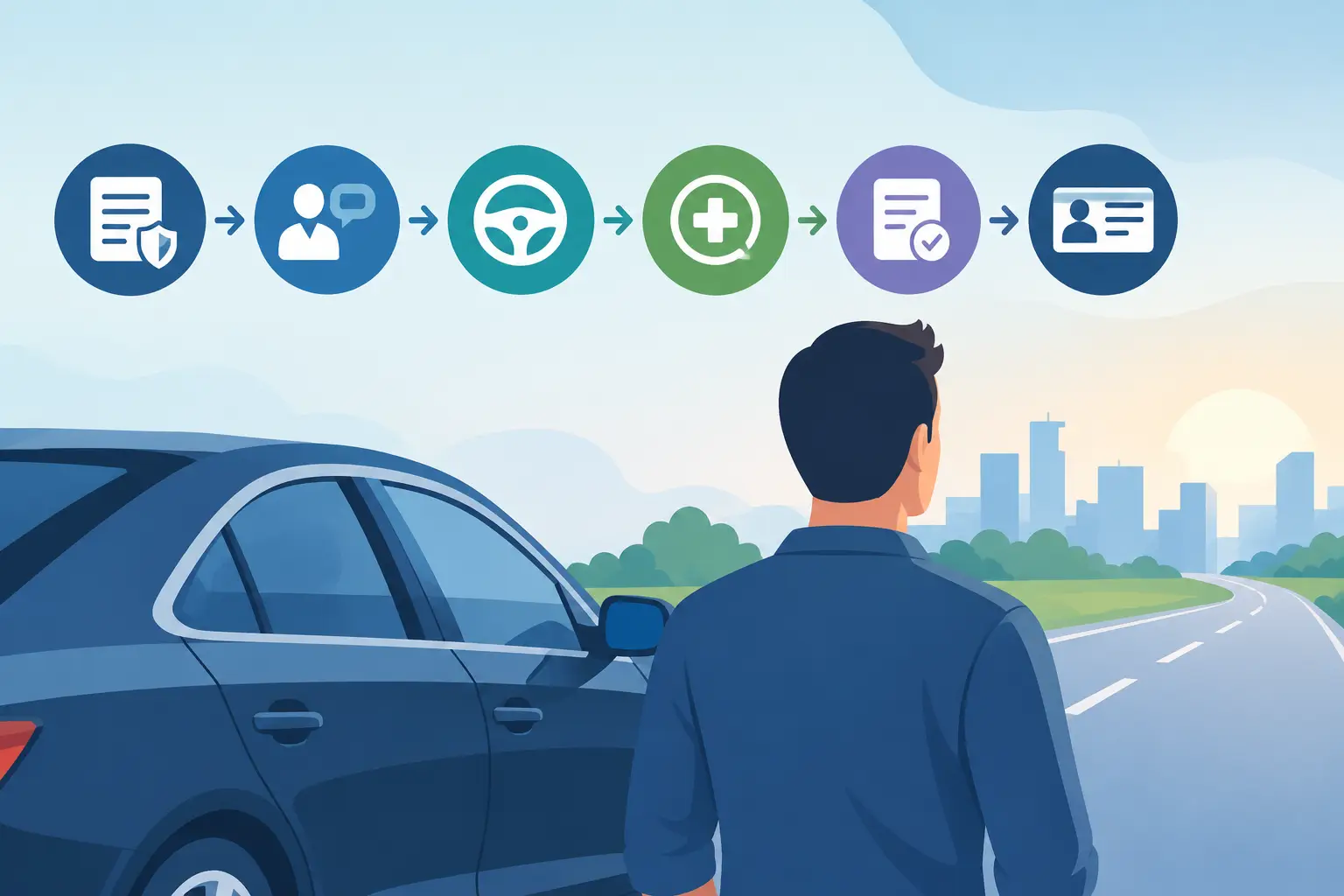
A DUI suspension can turn ordinary errands into a scheduling problem overnight. Getting your license back is rarely one task or one payment. It is a series of requirements handled by different agencies, often on different timelines. A successful license reinstatement after DUI starts with knowing exactly what your DMV requires, what your court or probation officer requires, and which deadlines apply to you.
The details vary by state and by the facts of the case. A first offense may involve a shorter suspension and fewer conditions than a repeat offense, a refusal to take a chemical test, an underage DUI, or a DUI involving injury. Your driving privilege may also be affected by separate actions from the criminal court and the state DMV. Treat each notice seriously, save copies, and confirm requirements with the authority that will approve your reinstatement.
1. Find Out Why Your License Is Suspended
Before you enroll in a course or pay a reinstatement fee, identify every active hold on your driving record. A DUI can result in more than one suspension. For example, the DMV may suspend your license through an administrative process, while the court may impose a separate suspension as part of sentencing.
Read your DMV suspension notice, court judgment, probation paperwork, and any correspondence from your attorney. Look for the beginning and end dates of the suspension, reinstatement eligibility date, required documents, and instructions for applying for a restricted or hardship license if one is available.
Do not assume that the date you finish a DUI program is the same date you can legally drive. Education completion is commonly one condition of reinstatement, not a replacement for the full suspension period. If anything is unclear, contact your DMV or probation office and ask what remains outstanding on your record.
2. Complete the Required Suspension Period
Most states require you to serve a defined period without full driving privileges. That period may begin on the date listed in a DMV notice, on the date you surrender your physical license, or after a separate administrative hearing. Missing a deadline to request a hearing can also affect how long a suspension lasts.
Some drivers qualify for restricted driving privileges during part of the suspension. These privileges may allow travel to work, school, medical appointments, court-ordered treatment, or a DUI education class. The rules are narrow. Driving outside the permitted purpose, time, or route can create a new violation and delay reinstatement.
If you are approved for restricted driving, carry the authorization with you and understand its limits before getting behind the wheel. Never rely on a verbal assumption that you are allowed to drive. Get confirmation from the DMV in writing whenever possible.
3. Finish DUI Education or Treatment That Meets Your Order
DUI education is one of the most common reinstatement conditions, but the required program is not the same for everyone. Your order may specify a number of hours, a victim impact panel, alcohol and drug education, counseling, treatment, live classes, or a state-approved provider. It may also name the court, county, DMV, or probation office that must receive your completion record.
This is where choosing the wrong program can cost time. A course may be legitimate educational programming but still not meet a particular agency’s format, hour, provider, or attendance requirement. Before enrolling, compare your paperwork against the program description. Confirm the required number of hours, whether online learning is permitted, whether live instruction is required, and where the certificate must be sent.
MyDUIClass provides online DUI education, alcohol and drug education, victim impact programs, and live instructor-led Zoom options. Students can save their progress, complete coursework around work and family responsibilities, and download a PDF certificate immediately after successful completion. However, the student remains responsible for confirming acceptance with the authority requiring the program before enrollment.
If your court or probation office requires a release form, enrollment verification, progress report, or direct certificate delivery, address that early. Waiting until your deadline to ask about documentation can leave little room to correct an administrative issue.
4. Meet Financial and Insurance Requirements
A suspension may remain active if unpaid fines, court costs, administrative fees, or other balances are still attached to your case. You may need proof that you have paid or arranged an approved payment plan. In some states, child support arrears, unrelated citations, or other license holds can also prevent reinstatement.
Many DUI drivers must file proof of financial responsibility, commonly called SR-22 insurance. An SR-22 is generally a certificate filed by an insurance company with the state. It is not a type of insurance policy by itself. Your insurer may require you to carry it for a set period, and a lapse in coverage can trigger another suspension.
Insurance requirements are one area where timing matters. Filing SR-22 too late can delay your ability to apply for reinstatement. Letting the policy lapse after your license is restored can undo progress. Ask the DMV how long financial responsibility must remain on file and keep records of your policy and filing confirmation.
5. Prepare the Documents for License Reinstatement After DUI
Once you are eligible, the DMV may require an application, reinstatement fee, proof of insurance, completion certificate, treatment discharge paperwork, ignition interlock documentation, or proof that your court case is resolved. Requirements can change based on your state, county, offense history, and whether you are seeking a restricted or unrestricted license.
Create a simple file for all DUI-related documents. Include copies of your suspension notice, court order, payment receipts, course certificate, SR-22 confirmation, ignition interlock records, and any correspondence from probation. Digital copies are useful, but keep originals when an agency requests them.
Before submitting anything, verify the recipient and submission method. Some agencies accept online uploads, while others require mail, in-person delivery, or direct reporting from a provider. A certificate in your inbox does not necessarily mean the DMV has received or processed it.
Allow processing time. Submitting documents on your eligibility date does not always mean that you can drive that same day. Check your driving status through the appropriate DMV channel and wait for confirmation that your privilege has been restored.
6. Follow Any Conditions After Reinstatement
Reinstatement is not always the end of the compliance period. You may still be required to maintain SR-22 coverage, use an ignition interlock device, attend follow-up treatment, avoid alcohol-related violations, or report to probation. A new citation or missed requirement can have serious consequences.
For drivers with an ignition interlock condition, learn the installation deadline, service schedule, reporting rules, and removal process. The device requirement may continue after you receive a restricted or full license. Removing it early or missing service appointments can result in additional suspension time.
Continue to check mail and official notices during this period. If you move, update your address with the DMV and court as required. Administrative notices sent to an old address can create problems even when you did not see them.
Common Mistakes That Delay Reinstatement
The most frustrating delays are often preventable. One common mistake is completing a course without confirming that it satisfies the order. Another is assuming that paying a court fine automatically clears a DMV suspension. The court, probation department, treatment provider, insurer, and DMV may each need separate proof.
Drivers also run into trouble when they confuse a certificate of completion with an active driving privilege. Your education certificate proves that you completed education. Only the licensing authority can restore your legal authority to drive.
Finally, do not drive until your reinstatement is confirmed. A suspended-license charge can add costs, extend restrictions, and complicate an already stressful case. If transportation is difficult, use permitted alternatives until the DMV record shows that you are cleared.
Getting your license back requires patience, accurate paperwork, and a willingness to verify each step instead of guessing. Keep your documents organized, complete the exact program required by your order, and give every agency enough time to process what it needs. That approach protects the progress you have already made and helps you return to driving legally.